


Air Master
Typically replies instantly
Typically replies instantly
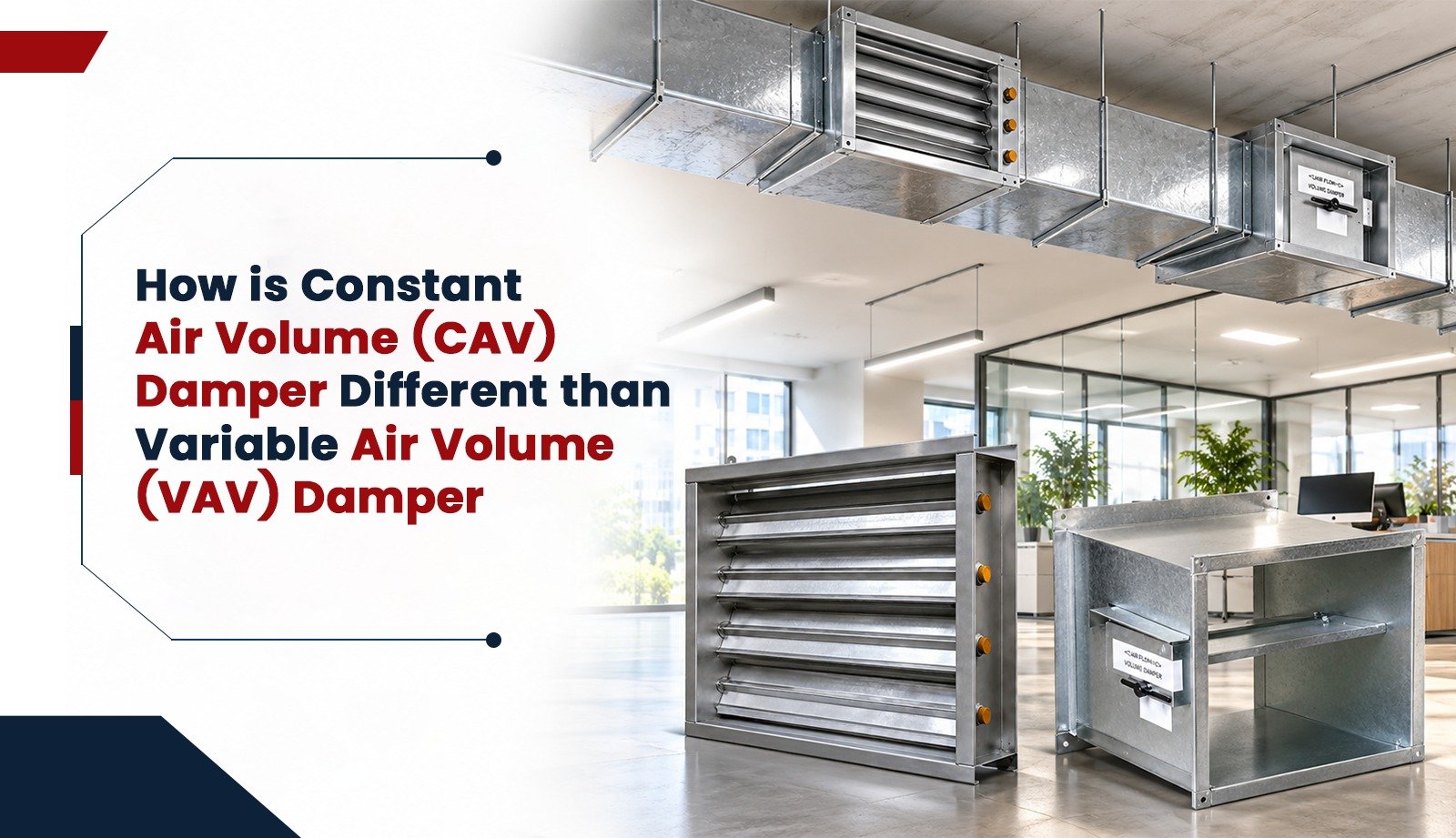
Efficient airflow control is essential for achieving occupant comfort, energy efficiency, and optimal HVAC system performance. Among the most commonly used airflow control solutions in commercial and industrial HVAC systems are Constant Air Volume (CAV) Dampers and Variable Air Volume (VAV) Dampers.
Although both are designed to regulate air distribution, they operate differently and serve different building requirements. Understanding the differences between CAV and VAV dampers can help HVAC consultants, engineers, facility managers, and building owners select the most suitable system for their application.
A Constant Air Volume (CAV) damper is designed to maintain a fixed airflow rate regardless of changes in room occupancy or thermal load. In a CAV system, the volume of supplied air remains constant while the temperature of the conditioned air is adjusted to meet the desired room conditions.
CAV dampers are commonly used in:
A Variable Air Volume (VAV) damper automatically adjusts airflow based on real-time cooling or heating requirements within a space. Instead of changing the air temperature significantly, a VAV system varies the quantity of conditioned air supplied to different zones.
VAV dampers are typically installed within VAV terminal units and operate through sensors and controllers that continuously monitor room conditions.
VAV dampers are widely used in:
In a CAV system, the airflow volume remains fixed. When cooling or heating requirements change, the HVAC system adjusts the supply air temperature while maintaining the same airflow rate.
This approach provides reliable ventilation but may consume more energy during partial-load conditions.
A VAV damper continuously adjusts its position based on signals from thermostats or control systems. When a zone requires less cooling, the damper reduces airflow. When demand increases, airflow is increased accordingly.
This dynamic airflow regulation improves comfort and reduces energy consumption.
|
Feature |
CAV Damper |
VAV Damper |
|
Airflow Control |
Constant Airflow |
Variable Airflow |
|
Temperature Control |
Variable Supply Temperature |
Constant Supply Temperature |
|
Energy Efficiency |
Moderate |
High |
|
Zone Control |
Limited |
Advanced |
|
Occupancy Adaptation |
Low |
Excellent |
|
Initial Cost |
Lower |
Higher |
|
Operating Cost |
Higher Over Time |
Lower Through Energy Savings |
|
BMS Integration |
Limited |
Excellent |
|
Occupant Comfort |
Standard |
Superior |
Energy efficiency has become a major priority in modern building design. VAV systems offer a significant advantage because they supply only the amount of air required by each zone.
During periods of low occupancy or reduced cooling demand, airflow is automatically reduced, allowing fans and HVAC equipment to operate more efficiently.
For large commercial facilities, VAV systems often deliver substantial long-term energy savings compared to traditional CAV systems.
CAV systems are straightforward to install, commission, and maintain.
The controls and equipment are generally less expensive than VAV systems.
Ideal for applications that require fixed ventilation rates for safety or process requirements.
Fewer control components can simplify long-term maintenance.
Airflow is delivered only where and when needed.
Each zone receives airflow based on its actual cooling or heating demand.
Demand-controlled airflow helps maintain healthier indoor environments.
VAV dampers integrate seamlessly with Building Management Systems (BMS), sensors, and advanced HVAC controls.
Reduced airflow during part-load operation often results in quieter system performance.
For most commercial buildings, VAV dampers have become the preferred solution due to their ability to improve comfort, optimize energy consumption, and provide advanced zone control.
However, CAV dampers continue to play an important role in industrial, healthcare, laboratory, and process applications where maintaining a consistent airflow rate is critical.
The ideal choice depends on building usage, occupancy patterns, energy goals, and HVAC design requirements.
Air Master offers a comprehensive range of HVAC airflow management solutions designed to meet the demands of modern commercial and industrial buildings. Our engineered damper systems are manufactured to deliver precise airflow control, energy efficiency, reliability, and seamless integration with advanced HVAC automation systems.
Whether your project requires Constant Air Volume (CAV) control for stable environments or Variable Air Volume (VAV) solutions for dynamic zone management, Air Master provides high-quality products tailored to your application requirements.
Both CAV and VAV dampers play a critical role in HVAC air distribution systems. CAV dampers provide dependable constant airflow and are ideal for applications with stable ventilation requirements, while VAV dampers offer dynamic airflow control, improved comfort, and significant energy savings.
As commercial buildings continue to focus on sustainability, energy efficiency, and intelligent HVAC operation, VAV systems are increasingly becoming the preferred choice. Selecting the right damper solution can significantly impact overall system performance, operating costs, and occupant comfort.
Air Master provides high-performance HVAC dampers engineered for efficient airflow control, superior durability, and long-term reliability. Contact our team today to discuss your project requirements and discover the right airflow management solution for your facility.